Beverage Processing Plant & Machinery Solutions
Beverage manufacturing splits into two routes: dry powders and leaf — coffee, tea, cocoa, milk powder and premixes — and liquids such as mineral water, soft drinks, fruit juice, coconut water and energy drinks.
Complete Beverage Process Flow
Green coffee, cocoa bean, tea leaf and dry ingredients are taken in and cleaned of stones, dust and tramp metal. Liquid lines take in water and concentrate instead, and treat it before use.
Bean is roasted, cooled and then ground or pulverised to the particle the brew method calls for. Tea and green tea skip roasting and go to sorting and blending.
Liquid feed is atomised and dried into a powder, agglomerated so it disperses when made up, and the fines are recovered from the air stream.
Coffee, tea, cocoa, milk powder, sugar and creamer are weighed out and blended to the premix recipe, then sifted before packing.
Syrup, juice, coconut water or energy drink base is mixed in tank, homogenised where it carries pulp or fat, and heat treated before filling.
Bottles and cans are rinsed, filled and closed, and mineral water runs the same route without a syrup stage.
Powder is auger filled into sachets, sticks or jars, leaf is filled into tea bags, and every pack is coded and labelled.
Product Pathways
Beverage plants are laid out by product route rather than as a single line. The five routes below are the common beverage products, each with its main stages and the machines used at each stage.
Route A — Hot beverages: tea, coffee and cocoa. Dry-side route producing blended tea, roasted and ground coffee and cocoa powder for hot drinks.
Green coffee bean, cocoa bean and made tea are cleaned of stones, dust and tramp metal. Tea is graded by leaf size and colour-sorted so that stalk and off-colour leaf are taken out before blending.
Coffee bean is roasted, cooled and ground to coffee powder. Cocoa bean is roasted, cooled and winnowed free of shell; the nib is ground to cocoa mass, and cocoa powder is milled from the press cake left after the butter has been pressed out. Tea leaf is not roasted and goes straight from sorting to blending.
Coffee powder, tea leaf and cocoa powder are blended to the recipe and sifted, then filled into tea bags, pouches or jars and coded.
Instant coffee — extraction, concentration and spray or freeze drying — is a separate route and is described on the Coffee industry page.
Route B — Fruit juice and pulp. Liquid route for juice, nectar and pulp from fresh fruit, packed in bottles, cups and pouches.
Fruit is washed, sorted for soundness and size, and stemmed, peeled or de-seeded as the fruit requires before it is cut.
Prepared fruit is crushed and the juice or pulp is screened away from skin, fibre and seed. Pulp for nectar and pulpy drinks is passed through a finer screen so that coarse fibre is reduced.
Juice or pulp is blended with sugar syrup and water in tank where the recipe calls for it, homogenised, and pasteurised before filling.
Hot-filled bottles are capped and cooled through a tunnel; cups and pouches are filled and sealed on their own lines, then coded and cased.
Route C — Carbonated soft drinks and energy drinks. Liquid route for carbonated and still drinks made from treated water, sugar syrup, flavour and, for energy drinks, a caffeine and vitamin concentrate.
Sugar is dissolved in treated water with heating, the syrup is filtered and cooled, and flavour, acid and colour are added to make the finished syrup.
Finished syrup is dosed into chilled treated water at the recipe ratio and carbon dioxide is dissolved into the chilled blend before it goes to the filler. Still drinks and non-carbonated energy drinks skip the carbonation stage.
Bottles and cans are rinsed, filled under counter-pressure so that the gas stays in solution, and then capped or seamed.
Filled containers are checked for leaks and fill level, coded and labelled, shrink-wrapped into packs and palletised for despatch.
Route D — Packaged drinking water. Liquid route for bottled water, cup and pouch water and large returnable jars.
Treated water is held in a closed tank and piped to the filler; the water treatment plant sits ahead of the packing line. Empty bottles and jars are conveyed to the rinser and rinsed before filling.
Bottles are filled and capped on one line; cups and pouches are filled and sealed on another; large returnable jars are filled and capped on a jar line.
Each container is date coded, labelled and checked for leaks and correct fill before it leaves the line.
Bottles are collated into shrink packs, stacked on pallets and stretch-wrapped for storage and despatch.
Route E — Powder premixes. Dry route for tea and coffee premix, cocoa and malt drink powders and instant drink mixes made from milk powder, sugar, creamer and flavour.
Milk powder, sugar, creamer, tea or coffee powder, cocoa and flavour are received in bags, tipped through a dump station, sifted and passed over magnets to catch tramp metal.
Each ingredient is weighed to the recipe and blended to a dry mix. Sugar may be milled finer first so that it does not separate from the lighter powders in the pack.
Where the premix has to disperse in hot water without lumps, the blend is moistened and dried into porous granules in a fluidised bed, with fines drawn off the air stream and returned to the bed.
The finished premix is auger filled by weight into sachets, sticks, pouches or jars, nitrogen flushed where the recipe calls for it, then coded, weight checked and cased.
Machinery Required for Beverage Processing Plant
- Material Handling Systems
- Pre Cleaner
- Destoner
- Magnetic Separator
- Coffee Roaster
- Cooling System
- Coffee Grinder
- Extraction System
- Filtration System
- Evaporator
- Spray Dryer / Freeze Dryer
- Agglomeration System
- Aroma Recovery System
- Packaging Machines
Turnkey Beverage Plant Solutions
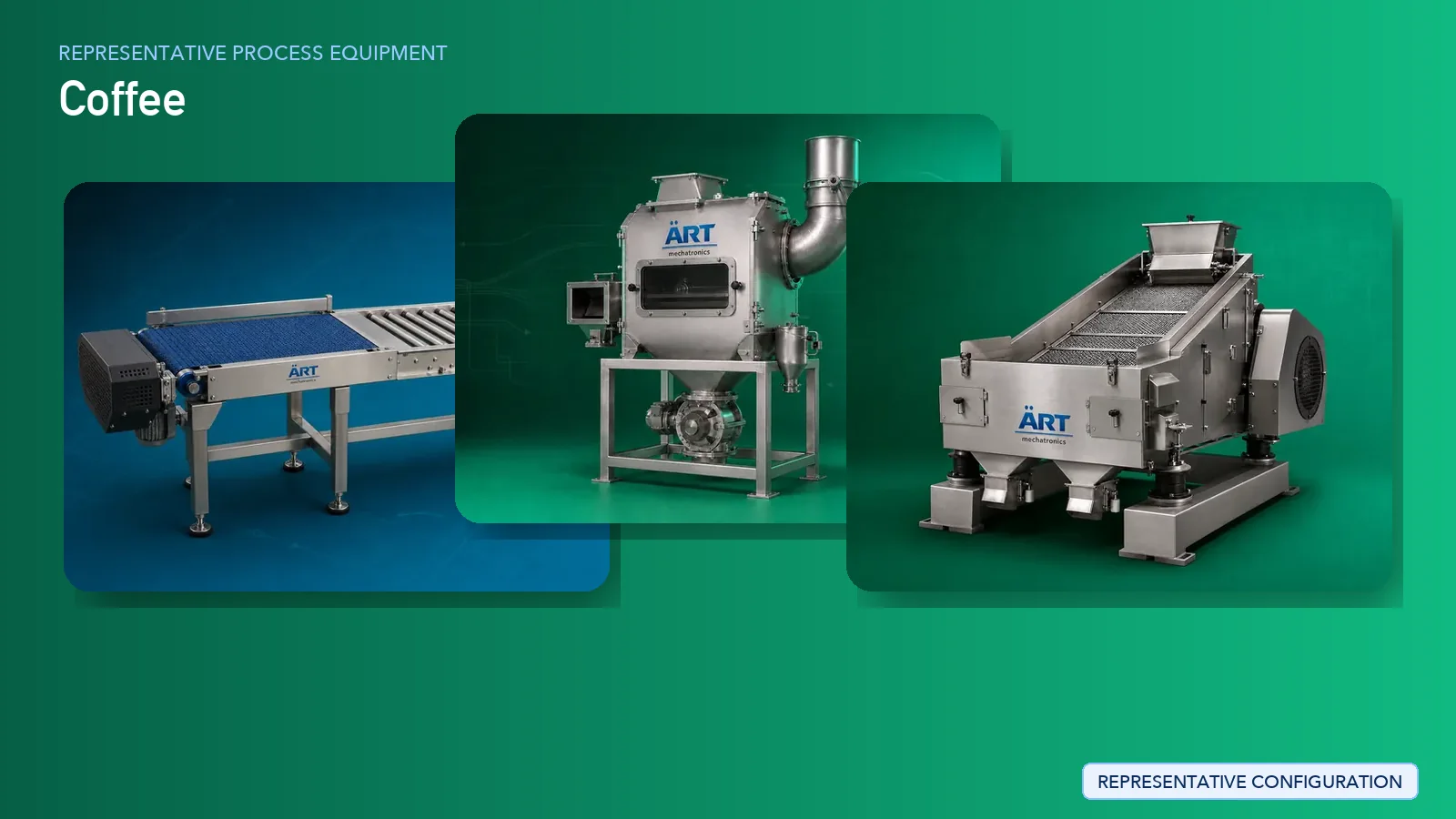
ART Mechatronics offers complete turnkey solutions for coffee processing plants, including:
- Process design & plant layout
- Roasting and grinding systems
- Extraction and drying systems
- Aroma preservation systems
- Automation & control panels
- Packaging line integration
- Installation & commissioning
- After-sales support
We customize solutions based on:
- Product type (instant, roasted, freeze-dried)
- Production capacity
- Automation level
- Packaging format
Why Choose ART Mechatronics
- Expertise in advanced beverage processing systems
- Precision roasting and grinding technology
- Advanced spray drying and extraction systems
- Aroma preservation capability
- High-efficiency automated plants
- Global export capability
Machinery in a Beverage plant
Where it's used
Get pricing & specs for the Beverage plant
Share the product, target capacity, current process and plant location. These details help our engineers discuss the right machine or line configuration.
One partner, from design to start-up
ART Mechatronics designs, manufactures, installs and commissions your Beverage plant solution with regional presence in India, UAE and Thailand.